Day 5, 7/9: BC (14500 ft) - C1 (18200 ft) - BC (14500 ft)
- byronzhang15
- Aug 4, 2019
- 3 min read
Updated: Aug 9, 2019
We make acclimation climbs is for a more successful summit bid. The human body doesn’t acclimate well first time we reach a new altitude, especially if the elevation gain is more than 1000m. However, once we’ve passed the uncomfortable phase, our body will have memories of how to adjust to the oxygen levels at that altitude, which is why acclimation climbs are so helpful and necessary.
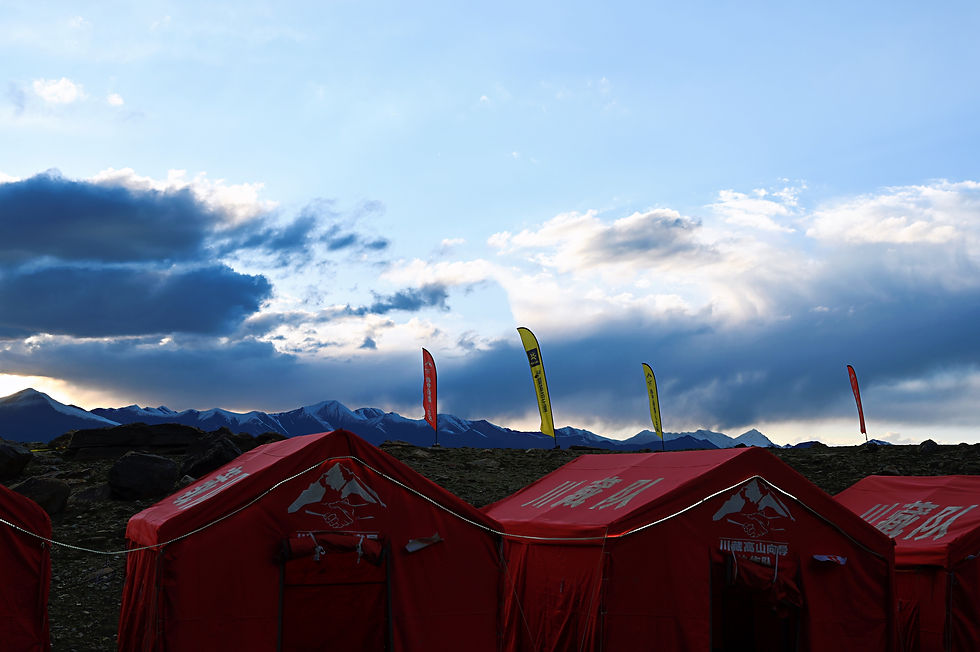
On Muztagh Ata, climbers usually make two acclimation climbs. The first one is done in a day, during which we travel from BC to C1, then back to BC on the same day. Today is the day of the first acclimation climb.

C1 is situated at 5500m (18200 feet), which was not too high relative to what most climbers on the team had done. The route has two sections, roughly equal in elevation gain: a rocky, dusty trail and then a snow slope. We left at around 12 p.m.

I’ve always hated rocky trails because they’re boring to walk on and hurt my feet. However, this one felt fine, probably due to the better fitness condition I was in. Once I’m on the trail, I felt how gigantic the mountain is again. Just the rocky section took us three hours, with good weather and virtually no wind.


Advanced Base Camp (ABC) marks the end of the rocky section. From there, we change into our climbing boots and snowshoes to ascend the subsequent snow slope. Acclimation climbs are also good for caching equipment like snowshoe. When we return from C1, we can just leave the boots and the snowshoes at ABC instead of carrying it up from basecamp again. Having 15 pounds less in the backpack really saves some energy when the time comes to summit.


The snow slope was TORTUROUS to walk on. Everywhere, besides people’s apparel, was just plain, white snow. Even with a pair 3+ rated mountaineering goggles, my eyes still got very irritated from looking at the white plane of snow. The slope itself is endless. The distance walked is probably half that of the rocky section, but it is significantly steeper. Muztagh Ata has a reputation of having very “gentle” slopes, yet my experience was that these slopes are not gentle at all.


One must not be tempted to look up when walking the snow slope. At ABC, you cannot even see where C1 is. After an hour of walking, you can finally see some yellow dots up high under the glacier of C2. Two hours later, the tents are not getting bigger. They’re still small. One specialty of Muztagh Ata was that, you can usually see the camp, but you can never get there.


After seven hours, I finally got to C1 at around 6 p.m.. I just had time to sip some water before the guides shouted everyone to descend, because it was getting very cold up there, and none of us brought out expedition suit along.

When I arrived at C1, I can already feel like there’s something wrong with my lungs. It hurts to breathe, eat, and drink. Therefore, I hurried down, even sliding at some snow sections and running at some rock sections (which was terrible for my knees). The consequence — I squeezed my toe nails to hard that the thumb became purple, and the pinky was blistered.

So the result of my first acclimation climb wasn’t great: injured lung, injured toe nails. Luckily, there were melons at basecamp. Thank God.


Comments